

Conquer Testosterone - Full Guide

Two years ago I started actively increasing my testosterone.
Around the same time, almost everything in my life coincidentally started moving in the right direction: energy, motivation, confidence, how much I achieved, stopping indulging in consumption and constant distractions...
Coincidentally? Yeah no.
There are a lot of moving pieces behind any real life change, but energy is a massive one, and testosterone is a huge driver of energy.
I always tell people to push their health metrics as high as they can. Not just for longevity, not just to avoid diseases down the line (although that’s pretty sweet too), but to maximize energy and enjoyment right now, in the present.
That’s what optimal health actually is: maximum energy. Energy is the driver for everything in life, every project you want to start, every relationship you want to build, every hard thing you need to push through. Not maximizing it is insane.
And as men, a huge part of that energy is driven by testosterone levels. It’s not the only thing but it’s honestly a big part of it.
I went from 634 ng/dL (which is apparently in the medium-high range, and I still felt like shit) to 913 ng/dL naturally, no TRT, no steroids. I’ll explain exactly how you can do that too.
But first, why does this matters so much? Most men have no idea what’s actually happening to their testosterone and what that’s doing to them.
The research
This chart is from a 2025 study of over a MILLION men.
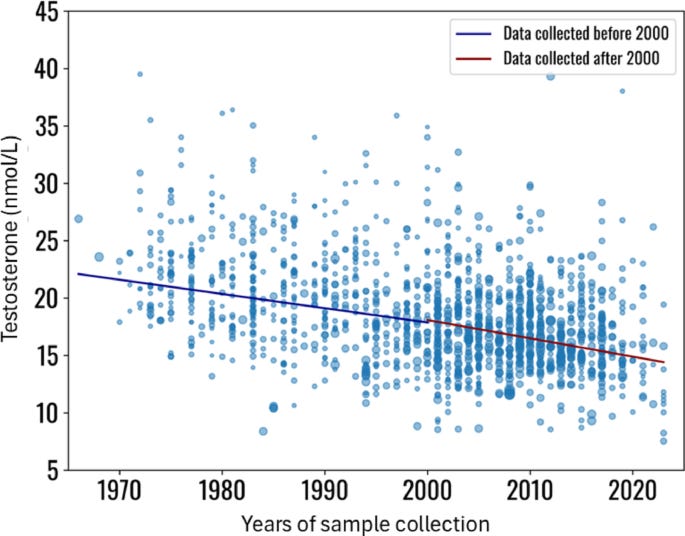
It shows that testosterone levels have been declining by roughly 0.56% per year since the 1970s. Compounded over 75 years, the average man today is walking around with way less testosterone than his grandfather or even father had at the same age.
This isn’t isolated to one country or one demographic. And the rate hasn’t slowed down.
The usual explanations are obesity, sedentary lifestyles, chemicals in plastics and water that mess with your hormones, processed food, less time outdoors. All real. But what’s more interesting than the cause is what it looks like when it plays out across an entire population of men:
Fatigue. Brain fog. Low motivation. Passivity. Anxiety. Depression. Low libido. Can’t build muscle. Can’t lose fat. Sleep gets worse (which makes everything else worse). Indecisive. Socially withdrawn. Going along with whatever the group thinks because you don’t have the energy to disagree.
That’s the symptom list for low testosterone. It’s also, almost word for word, the description of the average guy in his late twenties or early thirties who feels stuck and can’t figure out why. The guy going through a “quarter-life crisis.” The guy in his forties going through a “midlife crisis.” These guys go to therapy, read self-help, try to “find themselves,” switch jobs, wonder what’s wrong with them on some deep existential level. A huge chunk of what they’re feeling is hormonal and they have no idea.
Look around you
You already know what I’m talking about.
You know men who have energy, who are direct, who go after things. And then you have men who are just kind of there. Fine with everything, never push back on anything, drift around. They’re not stupid and they’re not lazy, they’re just flat. Like something turned off and they didn’t notice.
Now zoom out. Testosterone has been dropping for 75+ years straight and look at what’s happened. More men on antidepressants than ever. More men in therapy that goes on for years and changes nothing. More men who’ve just stopped competing, stopped taking risks, stopped going after anything hard.
We keep calling it a mental health crisis, a crisis of masculinity, a crisis of meaning, like it’s some deep mystery. The biology is tanked and we’re treating the symptoms while the cause keeps getting worse every year.
This isn’t new either. Societies that produce passive, comfortable men who avoid hard things don’t last. It’s a pattern historically. And right now we’re in the steepest testosterone decline in recorded history at the same time that young men are more passive, more anxious, and more lost than they’ve ever been. You can call that a coincidence if you want.
Testosterone drives competition, risk-taking, confidence, motivation, physical energy, sexual drive, the ability to push through things that suck. Take that away from an entire population of men over decades and you get what you see when you look around.
It changes how you think too
You always hear about muscle and libido when testosterone is mentioned. There’s a bigger thing.
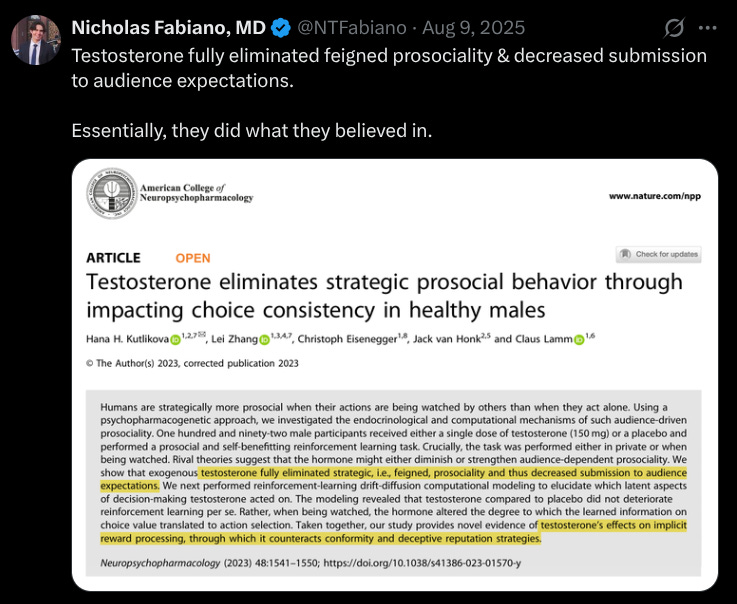
This study showed that men with high testosterone did what they thought was right wether someone was watching or not. Men with low testosterone acted nicer and more generous when someone was watching, essentially acting fake because they want to fit in the crowds.
That’s MAJOR.
First: low testosterone makes you easier to manipulate. When your biology is wired to filter every decision through “will people be okay with this” instead of “is this actually true,” you become incredibly susceptible to whatever the crowd is saying. If every screen you look at repeats the same thing, you’ll adopt that position, because your brain reads consensus as safety. You’re not asking “is this right,” you’re asking “will I get in trouble for disagreeing.” That’s how manufactured consensus works, and low T men are the easiest targets for it.
Second, low testosterone makes you less likely to innovate. If you want to do anything new, to build anything that doesn’t already exist, to leave your 9-to-5, to bet on yourself, you have to go against what everyone around you is doing. You have to look at a situation, decide for yourself that something could work, and then act on that even when nobody else believes it. That takes a specific kind of confidence, the kind where you trust your own thinking over the crowd’s opinion.
There’s a reason autistic founders are so disproportionately successful in business. They literally don’t process social consensus the same way, so they evaluate ideas on whether the logic checks out, not on whether everyone else thinks it’s a good idea.
Every major invention in history was someone breaking from how things had traditionally been done, going against what everyone thought was possible, and doing it anyway. That requires the ability to think independently of the group. And testosterone is part of what gives you that ability.
So when I say low testosterone keeps you stuck, I don’t just mean you’re tired and your lifts aren’t going up. I mean you will stay at your comfortable job doing what everyone else does, following the path everyone else follows, thinking what everyone else thinks, because your biology won’t let you break from the herd.
You’ll dream about the life you actually want and never take the risk to go get it because your hormones are telling you that safety is in the group and breaking away is dangerous.
If that doesn’t make you want to get your levels checked, I don’t know what will.
What this guide covers
I needed to write this because I speak of increasing testosterone often in many of my articles and it’s not right to tell you guys to “go watch some videos on it” when you ask me about it.
I’ve been the guy looking for answers and most of what’s out there is garbage: too shallow (just lift bro), too focused on selling you a supplement stack with affiliate links, or so clinical you need a biology degree to get through it.
I break it into three layers: biological, neurological, and psychological, because testosterone is an output of how your entire system is running. Your sleep, your nutrition, your stress, your nervous system, your sense of purpose, all of it feeds into the same number.
And the great thing about testosterone compared to most health metrics is that you can track it with a cheap blood test. You get an actual number. Any interesting game has a score you can track, and most people try to optimize based on how they “feel” which is vague and impossible to pin down. Testosterone gives you a scoreboard. You can turn this into a game.
What we’re going to cover:
the 20% of things that create 80% of the results for you to start feeling better as soon as possible.
the stuff that takes you from great to elite beyond that
the hidden killers that are suppressing your testosterone right now
why cortisol might be the single biggest reason your testosterone isn’t doing what it should even if your numbers look fine on paper
the exact bloodwork panel you should ask for so you actually know where you stand instead of guessing
supplement stack I used personally + whether quality and high price is worth it for every supplement (it’s not)
This is the guide I wish I had two years ago.
Now, let’s get you into the top 1% in testosterone levels.