
Everything Changed When I Stopped 'Working on Myself'

Every popular solution to the mental health crisis is making it worse.
Therapy, introspection, journaling, shadow work, “embracing boredom,” sitting with your feelings, healing your inner child.
These are the things our culture tells people to do when they’re struggling. And I think, for most people, they are the reason they keep struggling.
Recently Marc Andreessen went on David Senra’s podcast and said something controversial. Senra asked him about introspection, and Andreessen said he practices zero. “As little as possible. Move forward. Go.”
He said people who dwell in the past get stuck in the past, that all the modern ideas around therapy and self-reflection are basically a product of the early 1900s, Freud’s era, and that the great men of history didn’t sit around doing any of it.
Then he posted on X:

Elon Musk responded:
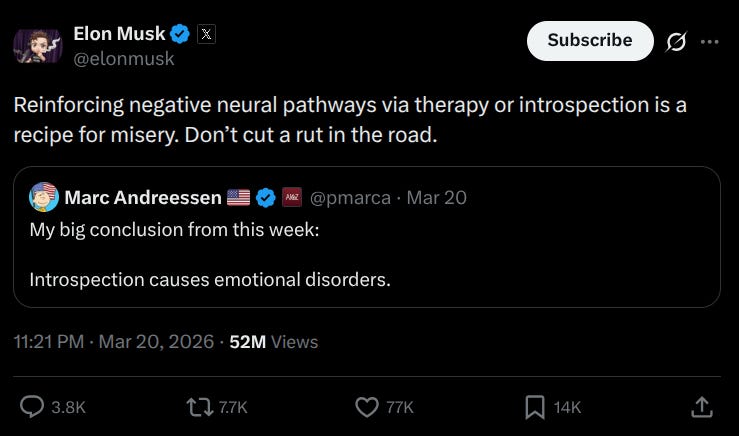
Many lost their shit in the replies: “They’re confusing introspection with rumination” “Easy for billionaires to say” “This is just repression with a tech bro label on it”
I read through many replies and most of them were some version of: you’re right that rumination is bad, but real self-reflection is different, and you’re being irresponsible by conflating them.
I think Andreessen and Musk are more right than the people correcting them.
I’m not saying introspection is always useless, I’ll get to that. But I think something important is happening underneath this debate that nobody has laid out clearly, and it goes way beyond whether you should journal or not.
I feel involved in this whole discussion. Five years ago I was broke, depressed, socially anxious, addicted to distractions, going nowhere. I went through all the lows you can think of, and many of them were made worse by exactly the kind of advice I’m about to tear apart.
I found my way out by doing the opposite of what I was told: I stopped trying to heal and started building. I built my health, my relationships, work that actually mattered to me.
Today I genuinely love my life. I run Conquer, I’ve written over 90 articles on human potential and ambition, I’ve spent years studying the psychology and biology behind what makes people thrive or stagnate. What I’m laying out here is the core of everything I’ve learned and everything I’ve lived.
I’ve been writing about this subject from different angles for months. I wrote about why the popular advice to “embrace boredom” backfires for most people. I wrote about what I called retrospective redemption: the idea that you heal the past by building an incredible present, not by processing your way to peace. I wrote about why Stoicism, even at its best, has a ceiling as a life philosophy. These felt like separate arguments at the time. They’re not. It’s all connected, and I only saw the full shape of it with this recent “zero introspection” debate.
The argument is this: the common thread behind introspection, boredom-seeking, therapy culture, shadow work, and most of what the modern self-improvement world sells you is PASSIVITY. Your attention gets pointed inward, backward, at yourself, at your past, at your wounds. And passivity isn’t just unproductive. It actively makes you worse. It causes the mental health problems that people then try to solve with more passivity. The prescription is reinforcing the disease.
But that’s only half of it, and honestly it’s the less important half. The reason people fall into passivity in the first place, the reason they reach for introspection and healing and boredom and shadow work, is because they have nothing pulling them forward. No real mission. No meaningful work. Nothing that answers the one question that every conscious human has to answer whether they realize it or not: what am I leaving behind when I die?
That question is where all of this leads. And I think it’s the thing that actually explains why so many people are struggling right now, in a way that “just stop overthinking” never will.
Let me start with what I mean by passivity, because it’s not what most people think.
What Passivity Actually Is
I don’t mean laziness. I don’t mean lying on a couch doing nothing. It’s something more specific: any sustained period where your attention is directed inward or backward instead of outward and forward. Introspection is passive. Rumination is passive. “Sitting with your feelings” is passive. Embracing boredom as a practice is passive. Even consuming content, podcasts, books, videos, all passive when it becomes a substitute for doing something with your life.
That distinction, inward/backward versus outward/forward, is actually the whole game. It’s the difference between reflection that works and reflection that destroys you.
Good introspection serves action. It looks outward and forward. You just shipped something, it didn’t land, you sit down for twenty minutes and figure out what to do differently next time. You’re reflecting on real experience, and the output is a decision about what to build next. The attention passes through you and points back at the world. That’s useful.
There’s a story from Walter Isaacson’s biography of Elon Musk that fits exactly. Grimes, his girlfriend at the time, said that Elon would sometimes sit upright on the edge of the bed in the middle of the night, completely still, in this “thinking man’s statue” pose for hours. Sometimes until dawn. She’d wake up periodically and find him in the exact same position, motionless, staring into space.
On the surface this looks like the most passive thing a person could do. He’s literally sitting on a bed staring at a wall. But his mind is aimed at SpaceX, at Tesla during production hell, at real engineering problems from real work that he’s going to act on the next morning. That’s not passivity. That’s the most intense form of outward-and-forward thinking there is, it just happens to look still from the outside.
Now compare that to someone sitting on the edge of their bed at 3am replaying their childhood, analyzing why they feel stuck, going through the same loops about their parents or their trauma. Same physical state, completely different direction of attention. One is processing real problems from real work. The other is excavating themselves. One produces something. The other just digs the hole deeper.
The problem is when that second kind of reflection becomes the main thing. When the ratio flips and you’re spending more time examining your life than actually living it. When it starts being the activity itself. When the direction of attention shifts from “what am I going to do next” to “why am I like this.” That’s when it turns on you.
I’ve watched this happen in my own life enough times to see the pattern clearly. Whenever I go through a heavy introspection period, lots of journaling, lots of thinking about where I am and where I’m going, it starts well. I get real insights. Useful ones. Things click into place about what I should do next, what I should change, where I should focus. But then very quickly it deteriorates. The insights dry up and the rumination takes over. My mental health starts to decline. Every time, without fail.
And for a long time I thought that meant I was uncovering hard truths that needed processing, that the discomfort was part of the healing. It wasn’t. The discomfort was the introspection itself doing damage. The good part, the insights, came because I had been taking action before and the reflection was serving the next action. That’s outward and forward. The moment it stopped doing that and became about me, my past, my patterns, my psychology, it became passivity. And passivity always makes you worse.
After this early reflection, I always had sufficient clarity and the best insights. I already knew what to do next, but since I had had results so positive from my earlier reflections, I kept going. When I then tried to reflect without that deposit, when I journaled and sat with my thoughts during periods where I hadn’t been building anything, I overthought. I felt worse, not better and the worse I felt, the more I thought I needed to examine. Which made me feel worse.
That’s the trap. And millions of people are sitting in it right now, convinced that the way out is to go deeper.
The Prescriptions
The modern self-improvement world has a handful of favorite medicines for people who are struggling, and they all sound wise, they all have some truth in them, and for most people they all do the same thing: keep you passive while feeling like you’re making progress.
Introspection and Journaling
I already laid out why this has diminishing returns. The part I want to highlight is Musk’s point about the rut in the road. Your brain doesn’t distinguish between processing a problem and rehearsing a problem, it just knows the path is getting deeper. And the deeper the path, the easier it is to fall into it again next time.
I know a guy, well into his 30s, who’s been doing this kind of work for years. Shadows, Jung, inner child, the whole thing. He hasn’t built much of anything in that time. Recently he said he was going to take a break to explore his shadow deeper. That’s where this leads when you let it run, the exploration becomes the project, the depth becomes the goal, and the life stays the same.
Boredom
There’s a popular idea right now that the modern world has stolen our boredom and we need to reclaim it: stop listening to podcasts on walks, turn off the radio in the car, sit in silence, let your mind wander. The pitch is that boredom is where creativity lives, that your subconscious does its best work when you’re not actively occupied, that we’ve drowned this natural process in stimulation and need to bring it back.
I’ve written about this in detail before, but let me restate my point quickly.
When someone with meaningful work, real problems to solve, things they’re actively building, embraces boredom, their mind wanders to those problems. They think about their project, have ideas about their business, their brain connects dots between things they’ve been working on. That’s genuine and productive, the boredom works because it’s processing real material.
When someone without any of that embraces boredom, something very different happens. Their brain has no meaningful problems to chew on, so it starts creating problems out of thin air instead. Anxiety, worry, replaying old failures, imagining future disasters. I’ll explain why this happens later, but the short version is that your brain treats unoccupied stillness as a threat, and when there’s no real danger, it creates some.
Prescribing boredom as a standalone practice is like noticing that elite athletes recover really well and concluding that everyone should just recover. Recovery works because of the effort that came before it, without effort it’s just sitting there.
I’ll tell you what happened when I went the other direction. Since I started writing and building Conquer about eight months ago, I’ve basically eliminated boredom from my life. Constant podcasts, constant reading, constant videos that are relevant to what I’m building, constant producing and publishing and taking action.
My attention is always pointed at something that moves me toward what I’m working on. Before that, I had a lot of downtime, plenty of unstructured hours, and I wasn’t better for it mentally, I was worse. Now that my mind is wired around this purpose and I’m acting on it all the time, the boredom question just disappeared. I don’t need it. I have real problems to solve and real work to do, and whatever processing my brain needs to do happens naturally in the gaps between all of that.
Therapy Culture
About 5% of the population has conditions that genuinely require clinical intervention. I’m not talking about them.
I’m talking about everyone else, and the massive error at the heart of modern mental health culture is that we’ve taken tools designed for that 5%, the therapy, the processing, the “healing,” the constant inward focus, and broadcast them to the entire population as though everyone needs them. We’ve told perfectly functional people that the way to deal with feeling lost or anxious or directionless is to sit in a room and talk about themselves for an hour a week, to look inward, to process, to heal.
These people don’t have a clinical problem, they have a direction problem. They don’t need to understand their attachment style or map their family dynamics or excavate their childhood, they need something to build, they need forward motion, they need their attention pointed outward at a problem worth solving instead of inward at themselves.
But what happens instead is they go to therapy and get very good at talking about themselves. They process, they have insights, they “feel heard,” they understand their patterns. And three years later their life situation is basically the same, but they have a much richer vocabulary for describing why.
Shadow Work and “Healing”
This is the most passive of all of them, and it might be the most damaging, because it tells you that you need to be fixed before you can start. The whole premise is that something is broken inside you, some wound from childhood, some unprocessed trauma, some shadow you haven’t integrated, and until you find it and heal it, you can’t build a real life. You have to go back before you can go forward.
This is what Andreessen was getting at when he said all of this was invented in the early 1900s. He’s talking about Freud and the whole tradition that came after him, Jung and Freud worked together at some point. The idea that your past is the key to your present, that your childhood determines who you are, that you need to dig backwards through layers of your own psychology before you can move forward. That whole framework is barely a century old, and somehow we’ve accepted it as obvious truth. It’s almost a law of physics at that point, if you criticize it, you get immediate backlash. The great builders and creators throughout history didn’t operate this way. They just built forward.
And this is where Musk’s point about “cutting a rut in the road” goes deeper. When you spend years analyzing your past, you’re not just wasting time, you’re locking your identity there. You’re rehearsing the story of how your childhood shaped you, how your parents failed you, how your traumas explain your patterns. And every time you go through that story, it gets more real, it becomes more you. Your past starts to own your future because you’ve made it the central character in your understanding of yourself.
Modern psychology actively encourages this. “Heal your inner child.” “Process your attachment wounds.” “Integrate your shadow.” Every one of these tells you that your past is the thing you need to deal with. So you deal with it. And deal with it. And deal with it. And your identity locks in around being someone who was damaged and is now healing, which is just a more sophisticated way of staying stuck.
So people spend years going back. They do the inner child exercises, they sit with their wounds, they excavate their past looking for the thing that explains why they’re stuck. And there’s always another layer, always another wound, always another pattern to uncover. The work never ends because you’re generating new material faster than you’re resolving old material. Your brain is perfectly capable of manufacturing an infinite supply of things to “heal.”
Meanwhile nothing in the external world changes. But it feels like progress because it’s hard, it’s emotional, it’s deep. You must be getting somewhere, right?
I don’t think you are. I think what’s happening is that you’re building an identity around being broken. “I’m someone who’s doing the work.” “I’m healing.” “I’m on a journey.” The process becomes who you are, and if the process is who you are, finishing it would mean losing your identity. So you never finish.
The causality is completely backwards. You don’t heal and then build. You build and the healing happens on its own. I wrote an entire piece about this called retrospective redemption. The short version: your present redeems your past, not the other way around. And the moment you start building, your identity shifts from “person who was broken” to “person who is creating something.” The past loses its grip because you have something more interesting to think about.
The Pattern
I haven’t even mentioned the most obvious form of passivity: scrolling. Doomscrolling, binge-watching, endless content consumption. These don’t even pretend to be self-improvement, they’re just pure passivity with no cover story. But they operate on the same mechanism as everything above: attention pointed nowhere useful, brain filling the vacuum with noise, hours passing with nothing built and nothing changed. At least shadow work feels productive, scrolling doesn’t even offer that illusion, and yet it’s how most people spend most of their free time.
Every one of these prescriptions keeps your attention pointed at yourself, and the trap tightens with every cycle. The entire self-improvement industry is built on selling you another turn of the screw.
Why Passivity Destroys You
Andreessen and Musk said introspection makes you worse. The replies said they were being simplistic. I think they were right but didn’t explain why, which made it easy to dismiss.
So let me explain why.
Human beings are built for forward motion. Your brain generates wellbeing through progress, through solving problems, through moving toward things. When you take that away and replace it with inward focus, you’re starving the system that keeps you sane.
You’ve felt this. Think about the times in your life when you felt genuinely good, not comfortable, genuinely good. Almost every one of those periods involved building something or working toward something that mattered to you. And the times you felt worst? Nothing moving, nothing going anywhere. Maybe you had comfort, money, free time, but no direction and no progress.
I think about my own worst stretches and they all had this in common. I wasn’t being challenged by anything, I wasn’t moving toward anything. I had free time and comfort and absolutely no forward motion, and my brain responded by eating itself alive. Anxiety about nothing, rumination about everything, a general sense that something was deeply wrong even though nothing was actually happening. That’s what passivity does to you from the inside.
And there’s a reason it works this way. For most of human history, if you weren’t actively doing something, it usually meant something was wrong, you were hurt, you were trapped, you were hiding. So your brain learned to treat stillness as a warning sign: when nothing is moving forward, ramp up the threat detection, start scanning for problems, generate anxiety and vigilance. That response kept your ancestors alive. It destroys you when you’re sitting in a comfortable apartment journaling about your feelings.
This is why people fall apart in passive situations even when their material needs are totally met. Unemployment does it. Retirement without purpose does it. Lockdowns did it to millions. The common factor isn’t hardship, it’s the absence of forward motion. Your brain reads passivity as a threat and responds with anxiety, rumination, depression. It’s doing what it’s supposed to do when nothing is moving.
When you repeat a thought pattern, your brain reinforces that pathway. Every session of replaying your childhood, analyzing your wounds, sitting with negative feelings, builds infrastructure for those thoughts to happen more easily next time. You’re not processing the negativity. You’re paving a road to it. The rut gets deeper with every pass, and eventually your thoughts fall into it without you choosing to.
The opposite is also true. When you’re building, solving problems, moving forward, your brain reinforces those pathways instead. Your default mental state shifts because you’ve rewired which tracks are the deepest. Action compounds upward. Passivity compounds downward.
Andreessen wasn’t being dismissive when he said introspection causes emotional disorders. That’s the passivity trap at the biological level.
The only way out is forward.
But that raises the obvious question. If forward motion is the cure, why doesn’t everyone just move forward?
Everything above has been the diagnosis. What follows is the part I’ve never seen anyone talk about clearly: why people fall into passivity in the first place, and what actually pulls them out. This connects to something fundamental about being human, about consciousness, and about death.
If you are not a paid subscriber, I think you had enough proof up until now to know whether or not what is coming will be good. If you want to push beyond the theory and support my writing, you can become a paid subscriber and get access to the rest of this article, as well as 25 other exclusive ones (including multiple long-form guides about things like confidence, purpose, focus, productivity, time, etc.)
The price is currently at 8$/month, or 80$/year, but it will increase to 10$/month on the 1st of May. For people that have subscribed before that date, the 8$ price will be permanently locked in and unchanged even after that date.
Multiple reasons for this increase: more available articles (and growing), a new series exclusive to the paid tier of readers case studies by me, and more content exclusive for people who want more from life but feel like they are letting it slip.
Now back to the article.