

Everything You Do Now Requires Discipline, It Didn’t Use To

As a kid you ran towards what you wanted and ignored everything else, the exhaustion, the scraped knees, because what you were chasing was more exciting than the pain.
You woke up springing from bed with a fire to discover the world. Nobody taught you discipline for this, you didn’t need any.
Now look at how you get yourself to do things. Systems, routines, habit trackers, a whole negotiation with yourself every morning just to start.
Funny thing is, it doesn’t even work: you keep falling back into ruts, and you feel like something’s wrong with you. It’s always swimming up river.
Somewhere between then and now the engine got swapped, everything that used to run on want now runs on forcing.
The usual answer to this is some version of “regain your childlike wonder”.
Sounds good, kind of doesn’t work.
You can’t walk backwards into childhood, but you can build back some of it.
The solution is to move forward instead of trying ot find something lost. Creation instead of regression.
We’ll not only try to find that childlike desire, but also the child’s first principles thinking, the ambition, the curiosity, and the innocence.
The camel, the lion, and the child
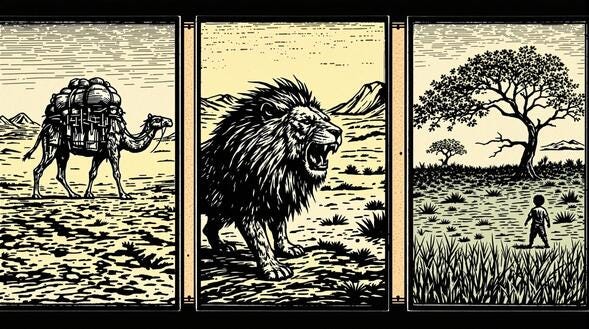
There’s a section near the beginning of Thus Spoke Zarathustra called the Three Metamorphoses, maybe two pages long, and I’ve thought about it since I read it years ago. Nietzsche says the spirit transforms three times: first it becomes a camel, then the camel becomes a lion, and the lion at the end becomes a child.
The camel is the loading phase, it kneels down and asks for the load, it wants the most difficult things it can find so it can feel its own strength carrying them.
Nietzsche lists the difficult things: humbling yourself to wound your own pride, going hungry for the sake of truth, loving people who despise you, walking away from your cause at the exact moment it triumphs. Hard, noble stuff. The camel loves the “thou shalt” (=you shall) the world gives it, holds it sacred, and takes real pride in how much it can bear.
Loaded with values, duties, and truths created by others, the camel walks into the loneliest desert. Admirable in endurance, but still defined by what it carries, not by what it creates.In the desert the camel becomes a lion, and the lion has one job: kill the dragon. The dragon is called “Thou Shalt”, it’s covered in scales and on every scale shines a golden “thou shalt”, thousands of years of values and rules, and the dragon’s message is that everything has already been decided, there is nothing left for you to decide.
The lion says “I will” and destroys it. This is the rebellion phase, the big No, allowing the freedom from imposed rules. And there’s a detail in the passage that makes this stage brutal: Nietzsche says the spirit once loved “thou shalt” as its most sacred thing, and now it has to find illusion in that same sacred thing. The dragon is built out of your own former beliefs, killing it feels like betraying yourself, and that’s a big part of why most people never do it.Last comes the child, and Nietzsche writes:
But say, my brothers, what can the child do that even the lion could not do? Why must the preying lion still become a child? The child is innocence and forgetting, a new beginning, a game, a self-propelled wheel, a first movement, a sacred “Yes.” For the game of creation, my brothers, a sacred “Yes” is needed: the spirit now wills his own will, and he who had been lost to the world now conquers his own world.
The child plays, and through its play it creates its own values, its own world, and it doesn’t need the old world as an enemy anymore.
Look at the order. The child is at the end. And this child is a different creature from the one you were at five, even if from the outside they look identical. At five you were innocent because you knew nothing. The child at the end of the sequence is innocent again after having carried everything and destroyed everything. It came back to the same place from the opposite direction.
This is why “regain your childlike wonder” never works as advice. It’s asking camels to imitate children, skipping two stages by acting out the third.
You already did the camel
I won’t spend long here because you lived it, probably twice.
The first loading you didn’t choose: school, grades, the career you were supposed to want, your family’s rules, maybe church on Sunday.
The second one you did choose, and this is the one that is tricky: the discipline era. The grind, the routines, doing hard things because hard things are virtuous, being quietly proud of how much you can endure. That’s still the camel, the camel wants the heaviest load it can find. Which means discipline itself, the thing this whole article is named after, sits at stage one of the sequence. The productivity world sells it as the destination.
And some of that loading is good, let’s be honest. You’re an idiot as a kid. Being told not to run on the road, or not to do the stuff that will literally kill you or leave you crippled, that’s rules doing their job. The problem is the process doesn’t stop there, it goes way beyond, and the rules that keep you in line get installed exactly the same way as the rules that keep you alive, by the same people, in the same tone. Somewhere in that process the fire and the excitement get lost too.
Most people never leave this stage, they carry until they die.
Where you probably are: the lion
If you’re reading Conquer my guess is you already killed a few dragons. You’ve seen through the career script, the life your parents had planned, most of mainstream self-help, most of what average people believe without ever checking it. You said your No, maybe loudly. I did the same, I said it hard enough that I left my country entirely.
But the lion is a trap, and Nietzsche saw it coming. If your identity becomes the No, you turn into a permanent rebel, the guy who can explain what’s wrong with everything and has built nothing with his freedom. I was that guy for a while. You see through the matrix, you feel superior about it, and years pass.
A quick test: can you say what you are FOR as easily as what you’re against? If the against list comes out instantly and the for list makes you think, you’re a lion, stuck at stage two of three.
The way out is not destroying more things. The way out is the child.
What the child has
“Wonder” is too vague to work with, so let’s be concrete. When I look at real kids, including the one I was, I count five things, and each of them got taken from you by a specific mechanism.
Desire louder than pain. The one from the intro, the engine you used to run on. The want was simply bigger than the cost, so the cost never registered, and no discipline was needed anywhere. Then society’s expectations kill it: the consensus, the family guidelines, religion, friends judging you. Almost everyone wants to belong, it’s one of the strongest human needs, and if you don’t listen and do what you want anyway, you get punished. So you comply, and the fire is the price. This is why everything in adult life suddenly requires “discipline”, the whole productivity industry exists because your wants became quieter than your pains.
Asking why until the adult runs out of answers. Kids haven’t had society’s rules installed into them yet, so they ask why, why, why, and get to the bottom of things without even trying. And the moment where the adult runs out of answers is the interesting one, because three whys deep most rules have nothing underneath, just “because that’s how it’s done”. You lost this one through punishment: asking why became rude, then naive, then a problem at work, and at some point you internalized the stopping point so deep you don’t feel yourself stopping anymore.
Saying the ambition out loud. A kid looks people dead in the eye and tells them he wants to be an astronaut, or the president. Who does that anymore? Everyone is ashamed of their grand ambition, or straight up refuses to have one. The kid doesn’t know yet that there’s a bill for saying it out loud. Then he learns it: the first laugh, the first “be realistic”, the first disappointed face from an adult he respects. By fifteen the ambition goes private, by twenty five it’s dead or hidden behind irony.
Curiosity. Ask questions, discover how things work, what’s beyond the corner, what’s on top of the mountain. I want to be precise on this one because I don’t think it died, it got captured. You still want novelty exactly like the kid, but now an algorithm feeds it to you in fifteen second pieces, made by people who are paid very well so you never have to go find anything yourself. The wanting is still there, the muscle that goes out and finds things rotted from never being used.
Innocence. A kid tells you what happened, including the embarrassing parts, keeping a second version of events hasn’t occurred to him yet. He’ll shout in a packed store that he shat his pants, zero remorse. I used to ask my great grandmother why she was still alive, because every year she told us she’d be dead by the next time we came to visit. There’s no gap between what the kid thinks and what comes out of his mouth. Then his first lie works, and from that day he’s keeping books: who was told what, which story goes with which person. And it’s simply a worse way to live, watching what you say so you don’t get caught in one of your lies, looking over your shoulder because you’ve done something wrong or you’re ashamed of something. Most adults have carried this so long they forgot it costs anything.
Here’s what the five have in common: the kid gets them all for free, and that’s exactly why they’re so fragile. His desire never chose anything, his honesty never survived a real price, his ambition never faced a room of skeptical adults. Life takes all five easily because none of them were ever defended.
The versions you can get back are built on purpose and paid for, and that’s what makes them stay. A desire you constructed yourself doesn’t die because a few people laugh at it. Honesty you chose knowing the full price doesn’t fold the first time it costs you something.
Below the paywall, how to rebuild each one:
How to construct a desire loud enough that the costs stop registering (and what keeps it from turning into stimulation chasing, because that road ends in drugs)
When tearing things down to first principles pays off and when it's wasted effort
What the research says about telling people your goals and who exactly you should tell them to
How to point your curiosity at one mountain instead of letting the feed graze on it
The handshake rule that makes trust an advantage instead of naivety
All five come down to the same swap: back to running on want, so you can stop swimming up river.