

Intelligence Doesn't Matter Without This Trait

Conquer Truth Tolerance - Full Guide
Truth tolerance is one of the highest-apex traits a human can have.
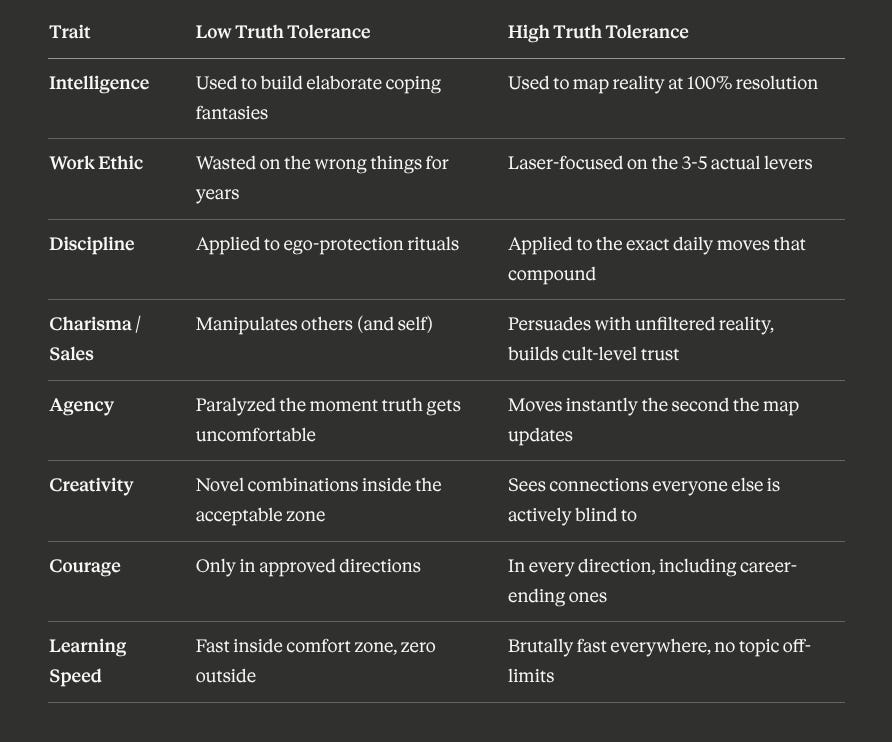
It sits at the very top of the pyramid, above intelligence, work ethic, charisma, discipline.
Why?
Because every other elite trait is multiplied by how much truth you can actually tolerate.
Intelligence with low truth tolerance gets used to build elaborate coping fantasies. Intelligence with high truth tolerance gets used to map reality at 100% resolution.
Work ethic with low truth tolerance means years wasted on the wrong things. Work ethic with high truth tolerance means laser focus on the 3-5 actual levers.
Discipline with low truth tolerance gets applied to ego-protection rituals. Discipline with high truth tolerance gets applied to the exact daily moves that compound.
Same pattern everywhere. Low truth tolerance means your traits only work inside the boundaries of what you’re willing to see. High truth tolerance means your traits work everywhere reality demands them.
Truth Tolerance Is Pain Tolerance
Truth is almost never neutral. Every major truth threatens something. Your self-image, your status, your relationships, your plans, your worldview.
When uncomfortable information appears, your amygdala responds the same way it does to physical danger. Your brain doesn’t distinguish between “I’m wrong about this” and “there’s a predator.” Both feel like threats.
For most people, the prefrontal cortex shuts down when ego-threatening information shows up. Cortisol spikes. Fight, flight, or freeze kicks in. The distortion happens before the information reaches conscious awareness. Your brain warps the data to protect you from the pain.
You don’t decide to lie to yourself. Your nervous system does it automatically.
This plays out everywhere. You do something for one reason, then justify it with another reason after the fact. You want to scroll social media because it feels good, then tell yourself you’re “staying informed.” You choose a political position because your tribe holds it, then build elaborate arguments for why it’s objectively correct.
This is the opposite of truth tolerance. Post-hoc rationalization. Self-manipulation. Your brain serving you comfortable lies instead of uncomfortable reality.
Your brain also has built-in distortions called cognitive biases. Confirmation bias makes you notice evidence that supports what you already believe. Availability bias makes recent or dramatic events feel more common than they are. Sunk cost fallacy keeps you invested in failing projects because you’ve already spent resources.
These are systematic errors in how human brains process information. High truth tolerance doesn’t eliminate them. It means catching them operating and compensating before they cost you.
Truth tolerance is the trained ability to experience psychological pain without your brain automatically distorting the information. It’s pain tolerance applied to information that threatens the self.
People with high truth tolerance have trained their amygdala to stand down when uncomfortable truths appear. An ego-threatening fact produces curiosity instead of defensiveness. “I was wrong” becomes “reality just gave me free information.”
This is why truth tolerance is rare. Reality hurts. Most people will unconsciously choose comfortable delusion over painful accuracy every time.
LLMs are the ultimate yes-men by default. They validate whatever you say, find reasons your ideas are good, agree with your framing. Most people use them as confirmation machines that make them feel smart.
Someone with high truth tolerance uses AI completely differently. They tell it: “Assume I’m wrong. Argue against this from first principles. Find every hole in my thinking. Show me where I’m bullshitting myself.”
They use it as an adversarial truth-finder.
I programmed every LLM I use to “be logical, reason from first principles, be 100% honest always, and only speak truth, not what I want to hear.” This AI tendency infuriates me. Having to second-guess whether the AI is telling me the truth or just pleasing me wastes energy. I don't want flattery, just tell me what's real.
The gap is enormous. One person gets an echo chamber that makes their delusions more sophisticated. The other gets hostile feedback on demand that they can interrogate.
Most people will never think to use AI this way. It’s uncomfortable. Why consciously have a machine tell you you’re wrong?
But that discomfort is the signal. If you can’t handle an AI contradicting you, you definitely can’t handle reality contradicting you.
The people who learn to use AI to stress-test their thinking instead of validate it will have a massive advantage. They’ll update faster, catch their own bullshit sooner, operate closer to reality than everyone using the same tool to feel good about bad ideas.
Why People Lose It
Truth tolerance isn’t stable. Even people who develop it can lose it under specific conditions.
Success is one trigger. The more you have to protect, the more painful corrective truth becomes.
Power is another. The higher you climb, the fewer people tell you when you’re wrong. They learn to soften bad news or hide it completely.
Identity inflation is the deadliest. When you fuse your sense of self with being right about something, admitting error feels like ego death.
Napoleon Bonaparte’s career shows this pattern clearly. He demanded brutally exact intelligence early on. He cross-checked reports by questioning ordinary soldiers. He read British newspapers daily despite vicious personal attacks because he wanted the clearest enemy picture. He welcomed advisors contradicting him in private.
This gave him a decisive edge for years. While enemies operated on hope or flattery, he operated on accurate maps.
Then it eroded. Success inflated his ego. He started installing brothers on thrones instead of competent administrators. The Continental System tried to force economics to bend to his will. By 1812 in Russia, his marshals were lying about troop conditions. He stayed too long in Moscow hoping reality would yield.
His fall had many more causes: logistical overreach, coalition dynamics, disease, structural constraints. But declining truth tolerance was part of the pattern. Success made being wrong too painful to bear.
This repeats everywhere. Founders who built companies by facing hard truths start surrounding themselves with yes-men after success. Investors who made fortunes being contrarian start believing their own mythology. Artists who broke through by being honest start protecting their brand.
The higher you climb, the more you have to lose by being wrong. Truth tolerance atrophies under that pressure.
How to Build It
Truth tolerance is a skill. It develops with practice. Here is how to do it: