
Your Community Is Programming You

This whole series of articles about programming I’ve published lately culminates on one idea: Attention. This is the highest leverage tool you will probably yield for the rest of your life, and I’m not even kidding. Get access to the full blueprint for Attention here.
For all of human history, if your community said “this is how things are,” you had two choices: agree or be shunned.
If you thought differently from the people around you, you kept it to yourself or you paid the price. The local culture had a monopoly on what was acceptable to believe, and there was no way around it.
The internet broke that monopoly.
For the first time ever, no matter where you were born or who raised you, you could find people who thought like you.
If you were an ambitious kid stuck in a small town where nobody read books, you could find readers. If you were fascinated by business in a family of factory workers, you could find entrepreneurs. If you disagreed with every assumption your culture handed you, you could find others who disagreed too.
This is extraordinary if you’re right. It’s dangerous if you’re wrong.
Culture manufactures capability
I grew up in an environment that wasn’t bad but didn’t fit me. Football, drinking culture, cars, video games, doomscrolling. Most people around me were happy with this. I wasn’t, but I didn’t know what I wanted instead, and I spent years struggling to find my footing because nothing in my immediate world pointed me in a direction that felt right.
The internet solved that. It was the first place where I could find people who cared about the things I was starting to care about: reading, bettering myself, building something, understanding how the world works. That discovery pulled me into a rabbit hole of self-improvement and entrepreneurship that changed the entire trajectory of my life. I found my tribe online because my tribe didn’t exist in my zip code.
This has always been how exceptional achievement works.
In the early 20th century, Hungary, a tiny country, produced like half of the world’s greatest mathematicians and physicists. Von Neumann, Erdős, Teller, Szilard, and many others. Other scientists called them “the Martians” because their genius seemed otherworldly, like they couldn’t possibly be from Earth.
They weren’t from Mars, but from Budapest coffee shop culture. The culture there had created something specific: gathering places where mathematicians discussed problems openly, where young people could observe and join, where intellectual passion was the social currency instead of sports or drinking or status. Their school created a culture of mathematical competition. Students competed in journals. The brightest minds mentored the next generation in cafes, not classrooms.
The environment that produces world-class thinking has consistent features: immersion from a young age, visible role models, a subculture that rewards the thing you want to develop, and the opportunity to practice with real problems. The Martians were raised in a culture that valued what they would become, and that culture created their capability.
The internet made this kind of culture accessible to everyone for the first time. You no longer need to be born in Budapest in 1900, or Athens in 450 BC when Socrates and Plato were arguing in the agora, or Florence in the 1490s when Da Vinci and Michelangelo were working streets apart, or Silicon Valley in the 1970s when the entire tech industry was being invented in garages.
Every one of those places manufactured genius through the same mechanism: a dense community where ambitious people could find each other, challenge each other, and raise the bar for everyone in it. You can join your own Budapest coffee shop from anywhere with a wifi connection. That’s the most powerful tool for human development that has ever existed.
But the same tool builds communities that manufacture the opposite.
Identity capture
This classic post explains the flipside better than I could:
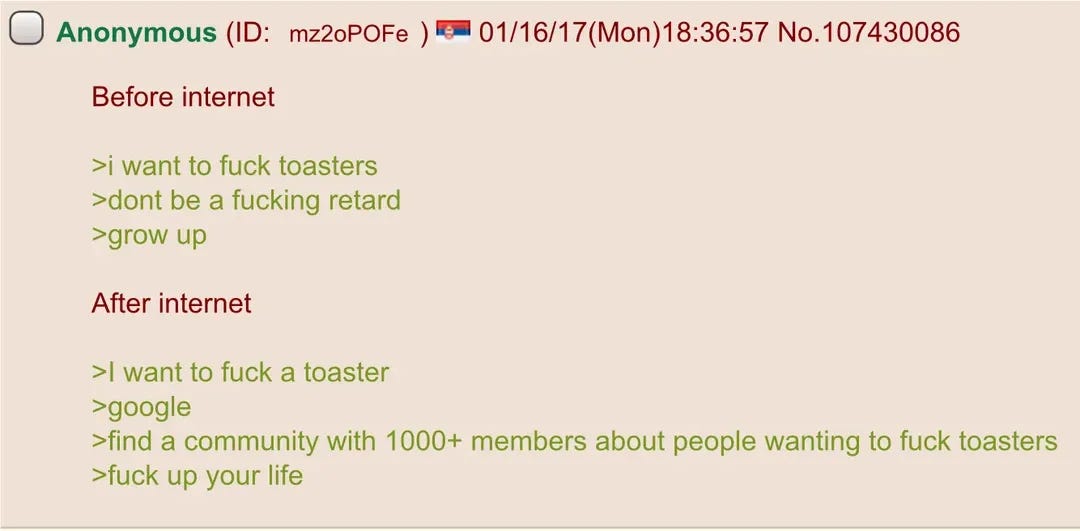
So it works both ways. Before the internet, your immediate community provided a check on your beliefs. Sometimes that check was wrong and oppressive ; sometimes it was right and necessary. Either way, it existed. Now that check is gone because you can always find a group that validates whatever you believe, no matter what it is (it also often happens in early adolescence, when you rarely have your brighest ideas).
At the same time, the way online communities work accelerates something dangerous and more subtle: the shift from “I’m going through something” to “I AM something.” There’s a massive difference between “I’m dealing with depression right now” and “I’m a depressive person.”
The first is a temporary state. The second is a permanent identity. Online communities push you toward the second because that’s where the full belonging unlocks. “I’m struggling” gets some sympathy. “I AM this” gets you a tribe, inside jokes, shared memes, a whole social world organized around the label.
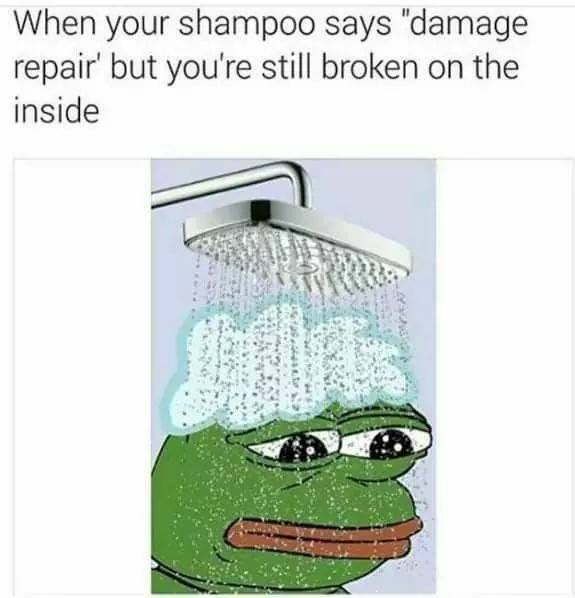
Once the identity is captured, the community becomes an addiction. The belonging is the drug. Your membership card is your dysfunction. And the community needs you to stay dysfunctional, because the moment you heal, you lose your place in the group. So the community doesn’t just fail to help you improve, it actively resists your improvement, and you’ll defend it because the belonging feels like the best thing in your life.
I almost fell into this myself. In my late teens, when I first joined Twitter, I started following depression accounts during a bad period. Memes about being broken, jokes about not wanting to get out of bed. It felt relatable and I was slowly sinking into it. If I had stayed in that rabbit hole instead of stumbling into the other one, who knows where I would have ended up?
This runs everywhere, politics is the classic examples on social media, everyone is in their own bubble of confirmation bias and cognitive dissonance.
The question
The Budapest coffee shops manufactured world-class physicists. Depression communities manufacture more depression. Political echo chambers manufacture misery. The mechanism is identical in all three cases: the community rewards a certain identity, you adopt that identity to belong, the social feedback reinforces it, and your biology locks it in. The only thing that differs is what the community rewards.
So look at your own communities. The accounts you follow, the group chats you’re in, the content that fills your feed every day. I’ve talked about right and wrong at the start, but that’s not for me or anyone to judge, that’s your job. The filter is:
Is your life actually getting better because of the communities you identify with? Not your feelings, your life. Are you more capable than a year ago? Are you building more, doing more, handling more? Or are you more comfortable with where you are, which is a very different thing?
The internet gave you the power to build your own Budapest. To find a culture that rewards what you want to become, regardless of where you were born. That’s extraordinary and unprecedented. But you have to point it in the right direction, and you have to be honest about whether the direction you’re currently pointed in is one you chose deliberately or one you fell into during a vulnerable moment.
Your tribe is programming you whether you realize it or not. Choose it like your life depends on it, because in a very real sense, it does.
Writing this piece made me want to build that Budapest coffee shop myself. A place where people who are serious about conquering their lives push each other forward. If that’s something you’d want to be part of, send me a DM:
I’ve talked a lot about programming lately, as I consider it to be one of the highest leverage thing you can change in your life. Continue with my trilogy about limiting beliefs:
How Your Own Beliefs Program You

You can literally wire yourself to believe what you want to believe. We’ve done it forever, only we’ve always been influenced by other people’s beliefs, not our own.
And if you really want to rewire yourself deeply, I have a product specifically created for this purpose:
Thanks for reading.
There is something about an in person interaction with someone who questions your stance on something that just can't be replicated online -especially in text and not face to face. When someone you see regularly in the community gives you the side-eye -or worse- explains exactly how you're wrong to your face, and knowing they tell other people in the community about it is a kind of social pressure that online just doesn't have. It all depends on what your community values and defines as 'acceptable'.
🔥🙌