

The Problem with Carl Jung

A guy joined a community of high achievers I was part of.
Mid-30s, high ambitions like the rest of us.
He had been doing shadow work for years already and started talking about it. Reading Jung, doing the inner work, introspecting, all of that.
After a few weeks he told us he needed to go deeper. He announced he felt there was still more shadow to deal with, so he left the community to focus on that for the next forseeable future.
I’ve been thinking about this since then.
This guy spent years looking inward. Years of reading, reflecting, doing the whole Jungian process. And his conclusion after all of it wasn’t “I’ve learned enough, time to build something with what I know.” It was “I need to go deeper still.”
This right here, is part of the problem I have with Carl Jung.
I’m not saying everything Jung said was wrong, and I’m not saying he never helped anyone.
My problem is that his philosophy, the way it plays out in a lot of people’s lives, often turns into an infinite loop with no exit.
Shadow work is a Minecraft world
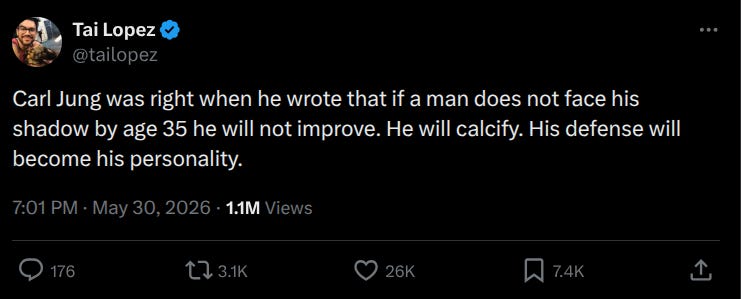
This exact same tweet goes viral all the time, people just love this idea it seems.
But what does “face your shadow” look like in practice? You start exploring. You find something, you process it, you “integrate” it. Then there’s something else behind it. And something behind that. You keep going because the philosophy tells you to keep going, the work is never done, individuation is a lifelong process. Jung’s words.
Noah Ryan put this better than I could:
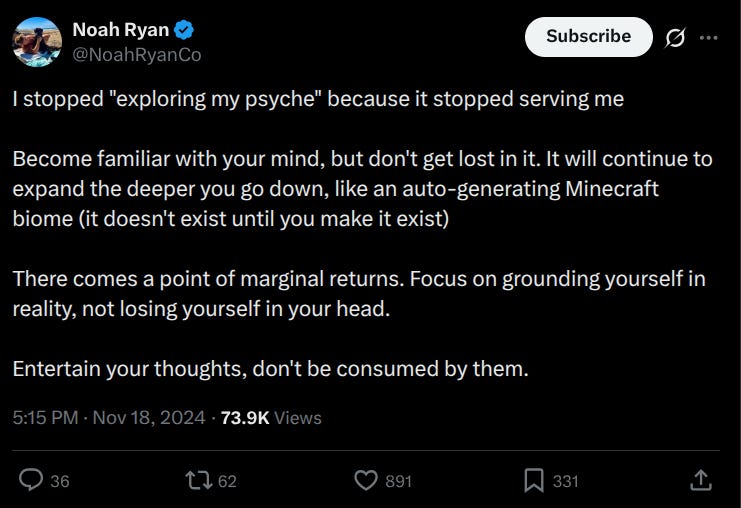
Shadow work operates like a Minecraft world. The terrain generates as you explore it.
It doesn’t exist until you go looking for it, and once you start looking, it will keep generating forever. There is no final room where you find the last piece and the process ends. The map expands the further you walk.
Jung himself framed individuation as lifelong. That’s supposed to be inspiring?
For me it’s a red flag. If the process never ends, and you’ve organized your life around the process, when do you go live?
The guy in the group chat had already done years of this. And the system he was following told him: keep going. There’s more. You haven’t gone deep enough yet. That’s not a path to completion, that’s a treadmill. And the treadmill is the product.
A bureaucrat’s philosophy
I’ll be honest, I haven’t read everything Jung ever wrote. I’m not going to pretend I did some exhaustive review of his work and I’m speaking from deep academic authority here. What I’m reacting to is what his philosophy looks like when it hits real people, what it asks of them in practice, and what it produces in their actual lives.
And in practice, this is what it asks.
You need to read his books (there are a lot of them, and they’re dense). You need to learn about archetypes, the shadow, the anima, the animus, the collective unconscious, synchronicity, individuation.
Each of these has sub-concepts and interpretive layers that branch into more sub-concepts. Then you need to apply all of this to yourself through years of introspection, ideally with a Jungian analyst who charges by the hour.
We’re talking hundreds of hours. Potentially thousands over a lifetime. All of it inward. All of it theoretical. All of it passive.
This is a bureaucrat’s philosophy. You’re doing paperwork on your own psyche, filing reports about your shadow, cross-referencing your anima with your childhood memories. And none of it requires you to do a single thing in the real world. You can spend a decade on this and not change anything about your external life. You just get better vocabulary for describing why nothing has changed.
I personally don’t know a single action-oriented person, a builder, someone who ships things and creates real things, who spends their time mapping their shadow and analyzing their anima.
The people I see deep in this stuff are almost always stuck. They read, they reflect, they journal, they discuss their inner work with each other online. And three years later their life looks exactly the same as it did before they started. They just have a more sophisticated explanation for why they’re still where they are.
The raft
There’s a thing I keep coming back to with philosophies like Jung’s. Not just Jung, but stoicism, Buddhism, a lot of modern therapy approaches too.
They’re rafts.
When you’re drowning, a raft saves your life. If someone is in real psychological crisis and they find Jung and it gives them a way to make sense of what’s happening, I’m not going to tell them they were wrong to grab it. The raft kept them from going under. That matters.
The problem is that people stay on the raft. They get comfortable. The raft becomes their identity. “I’m doing shadow work.” “I’m on a journey of individuation.” “I’m integrating my archetypes.” These become things people say about themselves, a whole identity built around being on a raft. They meet other people on rafts and they talk about raft life together. Years pass. They’re still floating in the middle of the ocean.
But, what if they had swum to shore instead?
Swimming to shore is obviously harder. We’re not debating that. You’re fighting the current, you’re exhausted, you can’t see the land.
But it’s shorter. You get there. You’re standing on solid ground and you can start building a life on something real, something you made with your hands, not on a set of concepts floating in the middle of nowhere.
Some people benefited from the raft. I did too, Stoicism helped me at some point in my life, but I used it to get to shore, I didn’t stay in the raft and made it my whole life.
Benefiting from something doesn’t make it the best option available. It’s great that you made it to a raft. But what if the help you followed had taken you all the way to shore?
Does this even fit you?
If you’re going to follow a philosophy (any philosophy, not just Jung’s), there are 3 points to consider:
Does it fit how your brain works? We are all different, a good reason you see many philosophies “work” is because they work for one specific personnality type. A simple example: If you have little in life, and no ways to make more, you will seek philosophies where equality is promoted. If you have a lot, or are confident about your abilities to make more, you will seek philosophies where freedom is promoted.
Does the ideal version of someone who follows this appeal to you? Not the theory of what a “fully individuated person” looks like in a book. The actual people you see in Jungian communities, online and in real life. Do they look like they’re building lives you’d want? Are they doing things you respect? Or are they perpetually processing, always one more insight away from being ready to act?
Is this an active philosophy or a passive one? Does it push you into the world or does it keep you in your head? Jung is passive. The entire system is built around inward examination with no clear exit point. And a philosophy that never tells you to stop looking inward and start building outward is, in my opinion, a dangerous one for anyone who wants to do something with their life.
Any philosophy can work if you believe in it hard enough.
Yeah, look around you. People live wildly different ways and make it work, but are they really happy? are they really living their potential? are they in a better condition for it? is the world in a better condition for it?
That’s impossible to answer objectively, but your gut instincts might have a clue.
Confirmation bias and cognitive dissonance will take care of the rest, we’ll always find evidence that it’s working and explain away the evidence that it isn’t.
That’s true for Jung, for stoicism, for anything. The question is whether it’s taking you somewhere real or whether it’s just a comfortable place to float.
Where this comes from
Jung didn’t appear out of nowhere. He came from Freud. They started as collaborators, and even though they split on a lot of things (Jung rejected Freud’s obsession with sex as the root of everything), they share the same fundamental assumption: the answers are inside you, buried in your past and your unconscious, and you need years of excavation to get them out.
This assumption is the thread that runs from Freud through Jung through modern therapy culture and into the water we all swim in now.
Adam Curtis covered this in Century of the Self (amazing documentary btw, you can find it on YT), how psychoanalytic ideas got picked up by advertising and politics and shaped an entire culture of inward-looking individualism.
Marc Andreessen talked about it on a podcast with David Senra, how the builder mindset is the opposite of all this, how the people who create things in the world don’t spend their time digging through their childhood looking for answers.
The whole tradition produces a society that thinks the answer to every problem is more introspection. More therapy. More processing. More “doing the work.” And the work never seems to involve building anything. It’s always inward. Always passive. Always one more layer to deal with before you’re supposedly ready to act.
You’re never ready. That’s the trap. The system keeps you preparing to live, indefinitely, which means you never start.
The shore
So what’s the alternative?
I’ve been writing about this for a while, and it comes down to something I call retrospective redemption. The idea is simple: you don’t fix the past by excavating it. You fix it by building a present so good that the past changes meaning on its own.
When your life is going well, when you’ve built something you care about, when you’re in motion and creating, the hard things you went through stop being wounds you need to process and start being the steps that got you here. The past reconfigures around a strong present. You don’t need to analyze it and integrate it through years of shadow work. You need to make it irrelevant by making your present undeniable.
That’s the shore. Solid ground that you built yourself.
I go into how this works in depth in a separate piece (linked below). But the core of it is this: action, building, forward motion, these aren’t things you do after you’ve finished the inner work. They are the work. Your past gets resolved in the process of building your future, not in the process of staring at your past trying to find one more shadow to integrate.
The people I admire, the ones whose lives I look at and think “that’s what I want,” none of them got there through decades of Jungian analysis. They got there by building things. And the building itself did what all the introspection was supposed to do. It made them whole. Not through excavation, but through construction.
Stop analyzing your shadows. Go build something.
It might be hard for you to believe this because Jung, Stoicism, Buddhism have been hammered into the culture so much they have become like laws of physics almost. Reconsidering them feels like reconsidering reality.
But do consider the idea, don’t discard it immediately. Seek the truth always and not general consensus/crowd thinking.
I go over retrospective redemption in detail in this article:
In this article I talk further about introspection:
Everything Changed When I Stopped 'Working on Myself'

Every popular solution to the mental health crisis is making it worse.
In this article I touch on the raft idea in more details:
Modern Gurus Teach You to Be Better at Being Miserable

Five years ago I discovered Stoicism during the big trend explosion. COVID had just hit and these faceless channels were blowing up everywhere teaching Stoic philosophy. I jumped in like everyone else.
In this article I talk about my problem with stoicism:
Stoicism Is Keeping You Small

Marcus Aurelius wrote the most popular passage in self-improvement almost 2000 years ago:
Check them out before discarding what is presented here.
Conquer.
The thing with introspection is that you have to put it with action. Introspection gives us insight on what to do and then act on it.
Knowing your psyche is good but doesn't mean that's the only thing you should do.
It also allows you to develop strengths you never knew. Like conquering certain weaknesses and then actively narrowing it.
Introspectiveness has become mental masturbation... great work Conquer (also big congrats on 10k!)